
Networking
Networking Event Entertainment: Why A Roving Magician Beats Small Talk
The first forty minutes of a networking event decide whether anyone actually networks. Here's what changes them.
- Published
- Reading time
- 6 min
Watch the opening half hour of almost any networking event in a Sydney CBD venue. Guests arrive, collect a drink and drift towards the walls. Colleagues find colleagues. Name tags go unread. The client you invited specifically to meet your team is studying the canapé menu as though it holds a secret.
Nobody planned it that way. It happens because walking up to a stranger is uncomfortable, and most rooms give people no good reason to do it.
The answer isn't more structure. It's something that happens to a small group of people, right in front of them, that they cannot stop talking about.
Why Most Icebreaker Activities Fall Flat
Name games. Bingo cards. “Find someone who has been to Peru.” Most icebreaker activities ask adults to perform in front of people they met ninety seconds ago, which is precisely what a nervous room doesn't want.
They produce compliance, not conversation. Guests complete the task, then retreat to the people they already know.
A genuine corporate networking ice breaker works the other way round. It asks nothing of guests except their attention. The conversation starts because something happened, not because someone was told to talk.
What A Roving Magician Actually Does To A Room
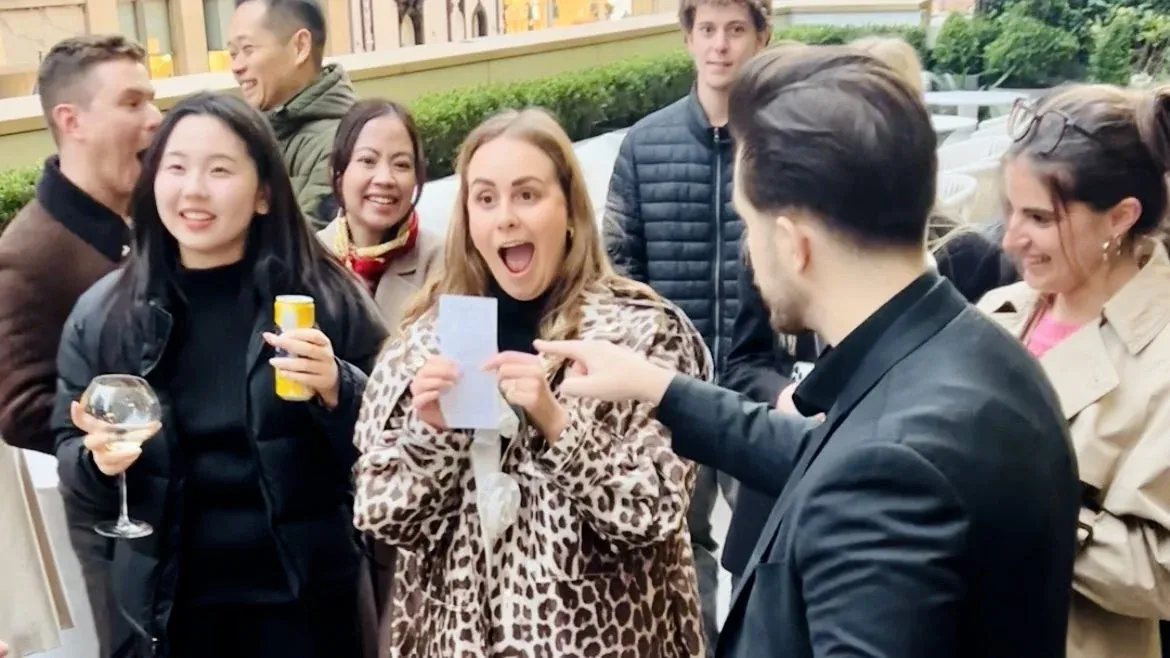
A roving magician moves through the room working small groups of three to eight people, a few minutes at a time. No stage, no microphone, nobody asked to stop what they're doing. Just walk-around magic that arrives, lands and leaves.
The interesting part isn't the trick. It's the ten seconds after it.
The Shared Moment Strangers Can't Ignore
Two people who have never met have just watched the same impossible thing happen. They look at each other. One of them says, “How did he do that?” and suddenly they're in a conversation neither of them had to start.
That's the whole job. A shared impossible moment gives strangers something small talk never can: a real thing to talk about.
The Conversation Starter That Travels
People who see something they can't explain tell the next group. Then that group wants to know what they missed. Within half an hour the room is talking to itself, and the event atmosphere shifts from polite to alive.
Reaching Every Guest
A skilled roving performer comfortably reaches around 70 guests per hour. For a corporate function of 140, that's two hours to make sure everyone has had their moment. Larger rooms call for a longer booking or a second performer, never rushed groups. The formats and timings are laid out in full on the roving magician hire page.
Why Mentalism Lands Harder Than Card Tricks
A close up magician working with cards and coins creates wonder. Mentalism creates something more useful at a networking event: it makes the moment about the guest.
When someone's private thought is named out loud, they become the story. Everyone around them leans in. And because it felt personal, it gets retold for the rest of the night, usually with their name attached.
There's a second layer most planners never see. Good roving magic is really about reading the room: which groups are open, which are mid-deal and should be left alone, who is hovering on the edge and needs bringing in. That's less a performance skill than situational awareness, and it's exactly what my years in plain-clothes policing were built around.
When To Start The Roving Magic
Timing matters more than most run sheets allow for.
- Cocktail hour: Start roughly fifteen minutes after doors open, once there's a critical mass but before people settle into safe little circles.
- Conference welcome events: Straight after registration, when delegates are tired, travel-worn and least likely to approach a stranger.
- Client entertainment: During the mingle and before any formalities, so the host speaks to a room that's already warm.
- Trade show activation: At peak foot traffic, where a crowd forming at your stand does more than any banner. Several of these trade show booth ideas that actually generate leads work on exactly that principle.
Pause for speeches. Pick back up straight after, when the energy in the room naturally dips.
What To Brief The Performer On The Night
The best networking event entertainment is briefed like a member of your team, not a hired act. Five minutes before call time covers it.
- Your key guests. Which clients or VIPs should have a moment, and who would rather not be singled out?
- Your hosts. Name the people who should be drawn into moments with clients. A shared laugh does more for a relationship than a business card.
- Groups to leave alone. The quiet corner where a deal is being discussed is not the place for a card trick.
- The run sheet. Speech times, food service and any hard stops.
- The room. Noise levels, no-go zones and where guests tend to cluster.
A brief like that turns roving magic from entertainment into a tool. It puts the right people inside the same moment, on purpose.
More Ways To Break The Ice
Roving entertainment works best in a room designed to mingle: high bar tables rather than banquet seating, food that moves, a host who circulates. For the wider picture, there's a full guide to networking event icebreakers and a longer list of corporate entertainment ideas that actually work for networking events in Sydney.
Why Planners Book Me For Networking Events
Most roving performers arrive with a set. I arrive with a read of the room.
Before I step into the first group, I've already noticed who's hosting, who's hovering on the edge, and which conversation shouldn't be interrupted. That's the habit of my years as a uniformed and plain-clothes police officer, where reading a crowd quickly wasn't a party trick. It was the job.
At a networking event, planners notice the result straight away. The right people end up inside the same moment.
What To Expect On The Night
- Mentalism, not novelty. Sharp, intelligent and built for adult corporate audiences. No props bag, no gimmicks.
- Zero tech fuss. Nothing to set up, plug in or schedule around.
- One performer, any scale. From boardroom drinks for 20 to a function of 800 or more.
- A brief that actually gets used. Your VIPs, hosts and no-go groups shape where I go and when.
- A room that keeps talking. The conversations nearly always start with the same sentence: “How did he know that?”
Cochlear, ServiceNow, Miro and Daikin have all trusted me with their rooms. As the team at Origin Energy put it, “He is engaging, smart and knew how to draw a crowd.”
FAQs
How many guests can a roving magician see in an hour?
Around 70 guests per hour in small groups, without rushing anyone. Larger events either extend the booking or add a second performer.
Does roving magic need a stage or AV?
No. Roving magic needs nothing but a room with people in it. No power, no microphone, no setup.
Is roving magic right for client entertainment?
It's one of the strongest fits. Clients leave with something memorable, and your team gets an easy reason to join the conversation.
How far ahead should I book for a networking event in Sydney?
As early as possible. Thursday to Saturday dates go first, and November to December is the busiest stretch of the year.
Ready For A Room That Actually Mingles?
If you're planning a networking event in Sydney and want guests talking to each other rather than their phones, start with Cameron's services, or see how booking a magician near you works. Cameron replies within one business day with availability and pricing.
About the author
More about Cameron